
Ottawa County Court Records After a Jail Arrest
Ohio counties use prosecuting attorneys, not district attorneys. In Ottawa County, Prosecutor Hon. James VanEerten's office is the local prosecutor's office tied to criminal charging decisions. The prosecutor's role after a jail arrest is to review, authorize, and file charges when appropriate. The formal court record begins when a complaint, information, indictment, citation, or other charging document is filed in the correct court.
A booking record and a court record are related but not identical. The jail inmate records side may show current custody, booking date, arresting agency, bond, holds, and initial charge descriptions. The court record shows the filed case and later action by the prosecutor, judge, clerk, and parties. For booking-photo questions, use the jail roster mugshots page; the court systems do not promise mugshots and should not be treated as a booking-photo database.
How to Find Ottawa County Court Records After an Arrest
Ottawa County has several court-record channels. The Clerk of Courts public records page describes searches by name or case number across Common Pleas, felony criminal cases, domestic relations, civil cases, appeals, certificates of judgment, county court traffic, and criminal cases. Municipal Court CaseLook is the path for many misdemeanor and traffic matters, but its disclaimer warns that online data may lag filings or judicial action by at least 24 hours and sometimes longer.
- Start with the jail roster if the arrest is recent. Record the booking name, arrest date, arresting agency, listed charges, bond fields, and any case or warrant numbers.
- Open the Ottawa County Clerk public records page and search by defendant name or case number where available.
- Use the Common Pleas record search page for felony or Common Pleas matters, and check the Common Pleas docket for scheduled hearings.
- Use Municipal Court CaseLook for misdemeanor, traffic, and municipal court cases, reading the disclaimer before relying on online results.
- Open the case record and read the charge list, court, case number, hearing dates, bond entries, warrant or capias entries, and disposition.
- For verified or certified records, contact the Clerk of Courts at 315 Madison Street, Room 106B, Port Clinton, phone 419-734-6755, or Municipal Court at 1860 E. Perry Street, phone 419-734-4143.
Statewide criminal-history checks are a separate product from local court search. Use official Ohio Attorney General or BCI channels where a lawful background-check product is required, and do not use casual online roster or court data for employment, housing, credit, insurance, or other FCRA-covered decisions.
Court Search Fields for Records After an Arrest
The researched court pages document the search channels, but some form fields sit behind disclaimer screens. Use the available online search first, then call or visit the court for verified status when timing, employment, bond, or court appearance decisions depend on accuracy.
| Portal | Field Label | Type | Required | Notes |
|---|---|---|---|---|
| Clerk public records / Common Pleas e-services | Name | Text | Optional | The Clerk says name search can locate individual records. |
| Clerk public records / Common Pleas e-services | Case Number | Text | Optional | Use when the roster, citation, warrant, or court notice provides a case number. |
| Municipal Court CaseLook | Search fields after disclaimer | Not fully captured | Not confirmed | The disclaimer was visible, but command-line access did not expose the form fields. |
| Common Pleas docket | Plaintiff/Defendant or Case Number | Link/search | Optional | The docket page links to search by party or case number and warns to confirm hearings by phone. |
The Clerk public records page explains the local case-search coverage for Common Pleas, felony criminal, county court traffic, and other records.
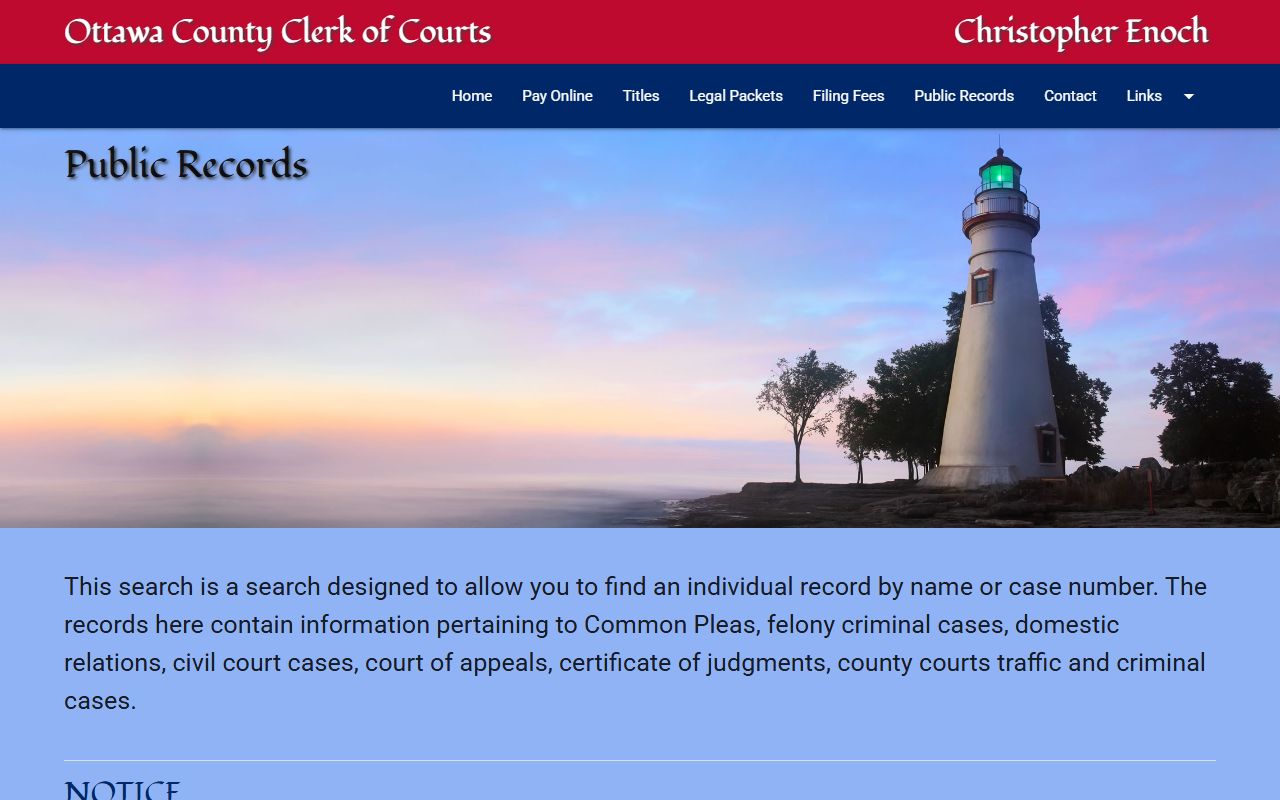
That page is the better starting point when the question is what court record exists after a jail arrest, especially when a jail roster charge may have changed once the case was filed.
Charging Documents After an Arrest: Complaint, Information, and Indictment
Charges after an Ottawa County arrest can begin in more than one way. A jail roster may show the arresting agency's booking charge. The court case may then begin with a complaint or citation, a prosecutor-filed information, or a grand jury indictment. Felony matters generally move to Common Pleas, while misdemeanor and traffic cases commonly appear in Municipal Court or county court channels.
| Document | Filed By | Common Use | Why It Matters |
|---|---|---|---|
| Complaint or citation | Officer or prosecutor | Misdemeanor, traffic, or initial felony proceeding | Often appears close to the arrest and may start the first court case. |
| Information | Prosecutor | Certain felony contexts when allowed or indictment is waived | Shows the formal prosecutor charge and may differ from the booking charge. |
| Indictment | Grand jury | Serious felony matters | Can add, change, or narrow charges after the arrest and booking entry. |
| Amended charge | Prosecutor or court order | Plea negotiations, corrections, reductions, or dismissals | Explains why the court record and original roster charge may not match. |
Charge Status in Court Records After a Jail Arrest
Charge status changes as the case moves. A person can be arrested and booked under one allegation, formally charged with another, have a charge amended, receive a dismissal, or resolve the case by plea or trial. Do not treat the original jail booking charge as proof that the court entered a conviction.
| Status | What It Means |
|---|---|
| Pending | The charge remains active and has not reached a final disposition. |
| Amended | The charge wording, code, degree, or count was changed after filing. |
| Reduced | The prosecution or court process changed the allegation to a lower-level charge. |
| Dismissed | The charge was terminated by court action and is not a conviction. |
| Nolle prosequi | The prosecutor declined to proceed on that charge, subject to the applicable record and court context. |
| Convicted / guilty | A plea or finding resulted in conviction on that charge or an amended charge. |
Bond and Release After an Arrest
The Ottawa County Municipal Court bond schedule, dated August 30, 2021, states that personal recognizance is the rule and that there is a presumption of personal recognizance for misdemeanor charges unless a statute or schedule exception applies. If an officer or prosecutor believes recognizance is insufficient, the judge or magistrate must be contacted for additional authority.
Felony charges and several listed misdemeanor categories may require judge or magistrate involvement. Examples in the local schedule include domestic violence or other offenses of violence involving a family or household member, protection-order or no-contact violations, aggravated menacing, menacing by stalking, sexually oriented offenses, certain OVI situations, and cases where a victim, officer, or prosecutor seeks a protection order or no-contact condition.
| Bond Type | How It Works Locally |
|---|---|
| Personal recognizance | Presumed for many misdemeanor charges; release is based on promise and conditions rather than cash. |
| Cash or surety bond | May be set when recognizance is insufficient or a judge/magistrate orders it under Criminal Rule 46. |
| 10 percent bond | The Municipal Court schedule lists misdemeanor amounts with "may post 10%" amounts and a $25 surcharge. |
| No-bond / hold until judge | Certain offenses may be held until a judge or magistrate sets bond, not longer than 48 hours after incarceration under the schedule. |
| Existing court-set bail | A previous bail or capias/warrant entry remains unless a judge or magistrate changes it. |
Holds can prevent release even when one bond is posted. Another county warrant, probation or parole hold, federal hold, ICE detainer, or court no-contact/protection-order condition can keep someone in custody.
Warrants That Lead to an Arrest and Court Records
No official standalone Ottawa County Sheriff's Office active-warrant search page was located in the researched sheriff menus. Warrant information may still appear through the jail roster if the warrant led to booking, through Municipal Court CaseLook for misdemeanor or traffic bench warrants and capias entries, or through the Clerk/Common Pleas search for felony warrants, indictments, and capias entries.
Warrant records may include defendant name, case number, court, charge, warrant or capias date, bond amount or no-bond status, issuing judge or court, status, next hearing date, and holding or transfer agency. For safety-sensitive or self-surrender questions, call the issuing court, the sheriff, or an attorney. Online case data may be delayed, and Municipal Court specifically warns that online data can lag at least 24 hours.
Charges vs. Convictions in Court Records After Arrest
An arrest and filed charge are accusations. A conviction requires a guilty plea, no contest plea with finding, jury verdict, bench finding, or other legally recognized disposition. The Clerk page warns prospective employers not to base final hiring decisions on online information and says a call to the court with jurisdiction can help determine final conviction status.
| Charge | Conviction | |
|---|---|---|
| Stage | Accusation or formal filing after arrest | Final finding or plea on an offense |
| Proof level | Probable cause or charging authority | Beyond a reasonable doubt for trial, or valid plea process |
| Where it appears | Jail roster, complaint, information, indictment, docket | Disposition, judgment entry, sentencing entry, certified court record |
| Risk of error | May be amended, reduced, or dismissed | Still verify with the clerk for certified or final status |
Sealed vs. Expunged Court and Arrest Records
Ohio Revised Code 2953.32 provides the general pathway for eligible sealing of conviction records. Sealing and expungement are legal processes handled through the court, not through a roster search box. If a case is dismissed, sealed, or otherwise subject to a court order, the court record should be addressed first and then affected sheriff or clerk records can be handled under that order.
| Sealed | Expunged | |
|---|---|---|
| Public visibility | Generally hidden from ordinary public access after a valid order. | Treated more strongly as removed or destroyed where Ohio law allows. |
| Agency access | Some law-enforcement, court, or licensing access may remain under statute. | Access is more limited, but exact effect depends on the order and law. |
| Eligibility | Depends on Ohio statutes, offense, timing, prior record, and disposition. | Depends on the specific Ohio expungement authority and case type. |
| Practical step | File in the court that controls the case and follow local clerk requirements. | Use the court process; do not assume a website can erase official records. |
Restricted Court Records After an Arrest in Ottawa County
Ohio public-records law makes many records available, but it does not make every piece of criminal justice information public online. Juvenile records, sealed cases, confidential law-enforcement investigatory material, protected victim information, medical or mental-health records, and information covered by a court order may be withheld or redacted. The Municipal Court disclaimer also says online information may be altered, amended, or modified without notice, and verified information requires a request or visit during regular business hours.
The Ottawa County Municipal Court CaseLook page presents a disclaimer before search access.
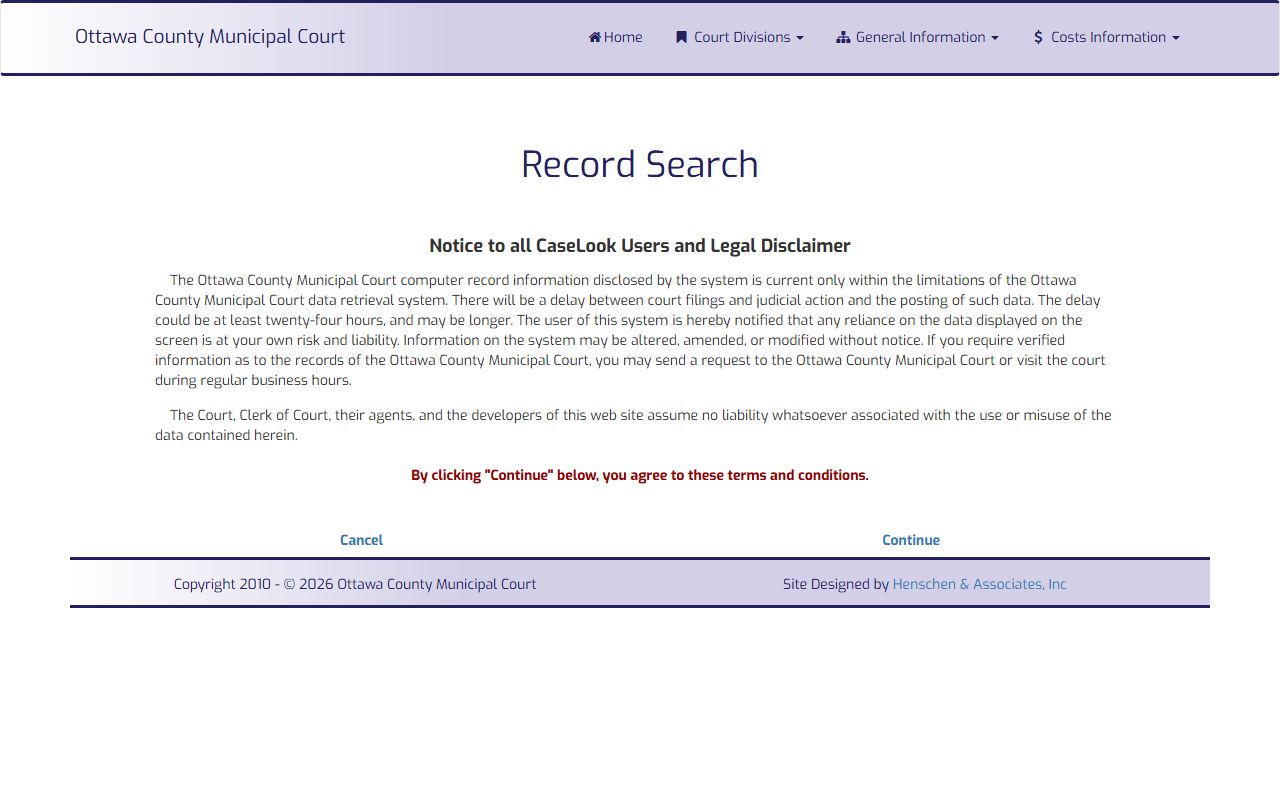
That disclaimer is important when checking court records after a jail arrest because a very recent filing, hearing, or bond change may not appear online immediately.
Background Check Considerations
Casual searches of court records after a jail arrest are not the same as a legally compliant background check. Online court indexes can help identify a case, but certified copies and official criminal-history channels are needed when accuracy and legal compliance matter. The Ottawa County Clerk can provide certified copies, and the court with jurisdiction can verify final conviction status.
Important: Do not use jail roster data or this non-government page for employment, tenant, credit, insurance, or other FCRA-covered decisions.